History: Flik
Preview of version: 12
|
| Plugin execution pending approvalThis plugin was recently added or modified. Until an editor of the site validates the parameters, execution will not be possible. |
Jaws
The jaw mechanism on the Flik (and the bigger Freehand as well) is perhaps the most intricate of any plier type multitool. In operation, the jaws function the same as many previous Gerber tools. Simply depress the two buttons on the handles and the jaws slide out and lock into position. Beneath the surface however, Gerber has engineered its way around a number of gripes, including jaw rattle and palm pinch. The result is a complex assembly of parts that seems to operate quite well.See photo at right
|
| |
plier opening sequence |
- STEP 1) Jaws are retracted. Mating "hooks" in the handles engage the jaws, locking the whole assembly together and preventing rattle.
- STEP 2) Press buttons and extend jaws.
- STEP 3) Open handles. Small tabs automatically engage. Pliers are ready for action.
Flik jaws themselves are somewhat stockier than those on previous Gerber tools. There are fine serrations near the nose, a gripping area below that, and a bypass wire cutter area near the pivot. (No hard wire notch is included.)
Handles/Frame
Flik handles are made of stainless steel, with a bead blast matte finish. They are formed into a triple-channel, a layout first seen on the original Leatherman Wave. This allows all the blades to be accessed without opening the pliers.GERBER and FLIK are stamped in large font on both faces. Small tool icons are stamped for the four large outside blades. (Note no inch or metric scales are included)
Blades and Tools
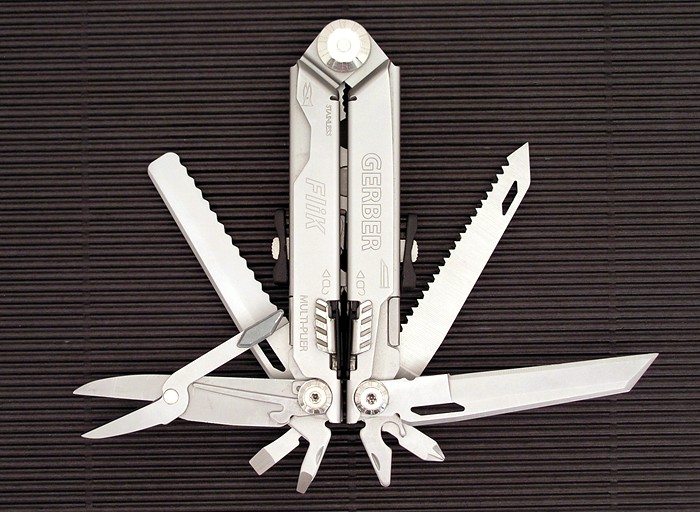
blades
All the blades and tools lock open. They are also completely free of clumping thanks to Gerber's exclusive tabbed washer system.
- Wharnecliffe knife blade with plain edge. Measures just under 3" long (72mm)
- Can opener
- flat phillips screwdriver
- saw blade
- Sheepsfoot knife blade with serrated edge
- Lanyard ring
- Combination bottle opener/medium flathead screwdriver
- Small flathead screwdriver
- Spring-loaded folding scissors
Locking Mechanism
The Gerber Saf-T Plus system securely locks all blades in the open position. Sliding the metal switch on the sides of the handle releases the lock.
Other Features
Sliding the lock switch in reverse causes the small blades to lift up slightly, making it easier to unfold them.
Sheath
A black nylon sheath with velcro closure is standard. It is designed for vertical carry only. It allows the Flik to be carried in either the jaws-retracted or jaws-extended position.
Dimensions
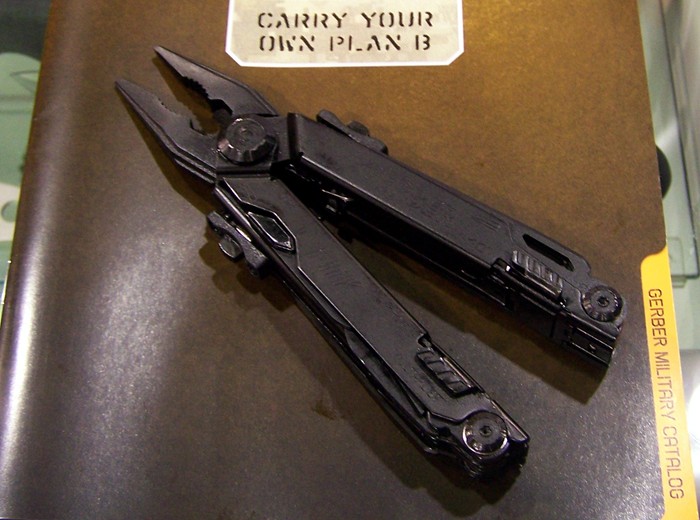
black oxide version
- Length open= 6" (150mm)
- Length closed = 4-3/8" (111mm)
- Width closed = 1-1/2" (38mm)
- Thickness = 7/8" (22mm)
- Weight = 8.7 oz (248g)
Variations
The Flik is also offered in a black oxide finish.
Background
Introduced by Gerber at the 2007 Shot Show, but was not generally available until early 2008. Tool and sheath made in China, jaws made in Taiwan.
Related Tools
The Gerber Freehand is essentially a larger version of the Flik.
More Info
- Flik review - on the Multitool.org Main Site
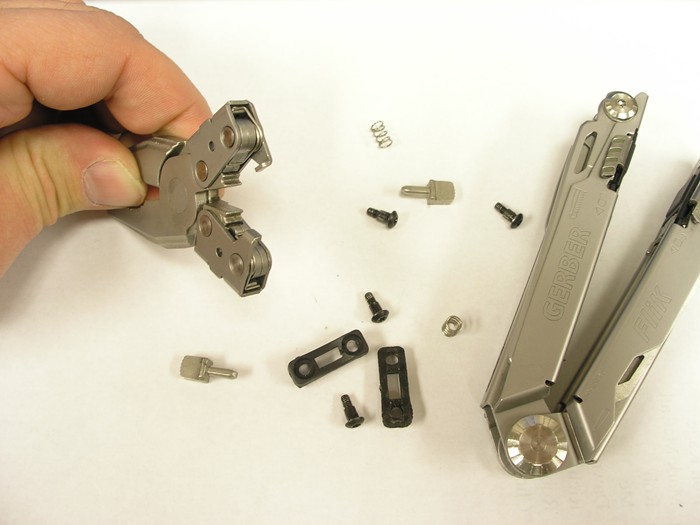
plier head disassembled
History
Search
Donate
Log In
|
| |
| blades | |
- Wharnecliffe knife blade with plain edge. Measures just under 3" long (72mm)
- Can opener
- flat phillips screwdriver
- saw blade
- Sheepsfoot knife blade with serrated edge
- Lanyard ring
- Combination bottle opener/medium flathead screwdriver
- Small flathead screwdriver
- Spring-loaded folding scissors
Locking Mechanism
The Gerber Saf-T Plus system securely locks all blades in the open position. Sliding the metal switch on the sides of the handle releases the lock.Other Features
Sliding the lock switch in reverse causes the small blades to lift up slightly, making it easier to unfold them.Sheath
A black nylon sheath with velcro closure is standard. It is designed for vertical carry only. It allows the Flik to be carried in either the jaws-retracted or jaws-extended position.Dimensions
black oxide version
- Length open= 6" (150mm)
- Length closed = 4-3/8" (111mm)
- Width closed = 1-1/2" (38mm)
- Thickness = 7/8" (22mm)
- Weight = 8.7 oz (248g)
Variations
The Flik is also offered in a black oxide finish.
Background
Introduced by Gerber at the 2007 Shot Show, but was not generally available until early 2008. Tool and sheath made in China, jaws made in Taiwan.
Related Tools
The Gerber Freehand is essentially a larger version of the Flik.
More Info
- Flik review - on the Multitool.org Main Site
plier head disassembled
History
|
| |
| black oxide version |
- Length open= 6" (150mm)
- Length closed = 4-3/8" (111mm)
- Width closed = 1-1/2" (38mm)
- Thickness = 7/8" (22mm)
- Weight = 8.7 oz (248g)
Variations
The Flik is also offered in a black oxide finish.Background
Introduced by Gerber at the 2007 Shot Show, but was not generally available until early 2008. Tool and sheath made in China, jaws made in Taiwan.Related Tools
The Gerber Freehand is essentially a larger version of the Flik.More Info
- Flik review - on the Multitool.org Main Site
| plier head disassembled |